Sanyo launches R410A VRF system
Sanyo
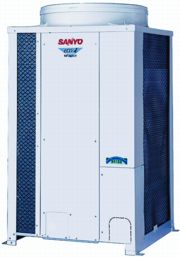
Sanyo’s ECOi R410A VRF air-conditioning system is claimed to achieve an industry-leading average COP for heating and cooling combined of 3.26.

Sanyo has introduced a VRF system using R410A for maximum efficiency and to achieve extended pipe runs of up to 150 m. In achieving the COP figures for the ECOi system, Sanyo has focused on efficiency in the cooling mode, which it argues is more appropriate than the heating mode, to achieve an average COP of 3.26 for heating and cooling combined, which is claimed to be industry leading in cooling mode. Four sizes of outdoor unit provide capacities from 6 to 12 hp and the capability of connecting up to four outdoor units in one system. Air-conditioning systems can thus have capacities from 16 to 125 kW and the ability to connect up to 40 indoor units. Noise level for the 10 hp outdoor unit is 55 dB(A), which is said to be 3 dB(A) lower than an industry-leading rival. A ‘silent-mode’ option reduces this sound level by a further 5 dB(A). The new range of ECOi indoor units units is designed to be backward compliant, fitting retrospectively to R407C and R22 systems. Among measures to achieve greater energy efficiency is the use of DC motors in the new XDR 4-way-blow cassette and the TDR ceiling-suspended unit. The XR cassette has been redesigned to offer a 950 mm-square panel throughout the capacity range from 2.8 to 14 kW. The ECOi system has a full LonWorks interface and an open protocol to accept DC input signals from any building-management system, as well as Sanyo’s own software for colour touch-screen operation.
Related links:


modbs tv logo

Lighting the way

Halesowen College has set a sustainability example for higher education institutions by installing smart lighting as part of its latest environmental initiative, making up to 85% energy savings compared to the previous system.

BESA updates HIU Test Standard

The Building Engineering Services Association (BESA) has announced an important update to its UK Heat Interface Unit (HIU) Test Standard, further strengthening performance benchmarks and supporting the sector’s readiness for incoming heat network regulation.