Passivent provides building modelling service
passivent
Three types of modelling to help achieve compliance with Building Regulations are included in a new service from Passivent.

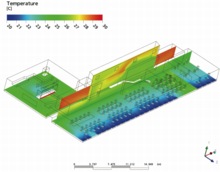
To help designers comply with Part L of the Building Regulations, Passivent has developed an environmental modelling service with the Institute of Energy & Sustainable Development at De Montfort University. This service provides three levels of evaluation. Dynamic thermal simulation geometrically models the entire building envelope. It takes into account all internal heat sources, including people and computers, and the effect of surrounding buildings. It can predict air changes per hour, internal carbon-dioxide concentration and hours exceeding peak internal temperatures. It does not model spatial distribution and assumes each room has a single, well mixed volume of air. Computational fluid dynamics establishes the detailed ventilation performance and thermal analysis of a building. It also shows how the appropriate regulations are met and that the ventilation system operates as intended. It provides data according to typical days and hours — not worst-case scenarios, as these are rare and short lived. Daylight modelling shows how natural illumination of a building and solar gain affects internal temperature, enabling judgments to be made on solar shading, type of glazing and the number and positioning of windows and rooflights — helping to achieve a realistic assessment of how the Sun will affect the ventilation and cooling strategy.
Related links:


modbs tv logo

ICOM celebrates Noah Gaunt as Apprentice of the Year 2026

Noah Gaunt of Vaillant Group UK has been named ICOM’s Apprentice of the Year 2026, recognising his outstanding commitment, technical excellence and passion for advancing the future of low carbon heating.

BCIA warns non-domestic buildings risk being overlooked despite decarbonisation drive

Commercial and public buildings risk being left behind in the UK’s transition to Net Zero despite more than £40 billion of funding, investment and policy support being directed towards building decarbonisation, according to the latest Policy Pulse report from the Building Controls Industry Association (BCIA).