Perkins high-pressure apparatus
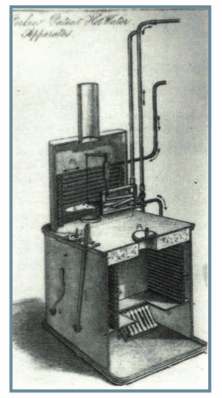
The pioneer of today's high-pressure-hot-water systems — the Perkins high-pressure water heater.
Jacob Perkins was born in Massachusetts in 1766. In 1816 he moved to England and secured a number of patents relating to boilers, steam engines and, most notably, a vapour-compression refrigeration machine. His son, Angier Marsh Perkins, born in 1799, also settled in England, where he devised his system of high-pressure hot-water heating. It used 25 mm seam-welded wrought-iron pipe of 6 mm wall thickness screwed together and tested before installation to 210 bar. About a sixth of the pipe was coiled and placed in a furnace. After filling all the pipework (except an expansion tube) with water, the system was sealed. When the furnace was lit, the heated water expanded, compressing the air inside and pressurising the system. A sufficiently high pressure was reached to sustain a flow of some 200°C. In 1840, Perkins published his booklet ‘Patent apparatus for warming and ventilating buildings’ in which he describes his furnace and lists numerous buildings where his apparatus had been installed. He also describes a heat-regulating device. His system was installed at the Royal Society for Arts, the London Patent Office, two sections of the British Museum and in Strathfieldsaye (the country seat of the Duke of Wellington). However, the very high operating pressures and temperatures reached by his system caused considerable concern, so he introduced a safer medium-pressure system that soon displaced the original. The system eventually fell out of favour because of the high premiums charged by the Fire Assurance Companies, but the principle paved the way for the large HPHW systems of the mid-20th century.