Radio-addressable emergency lighting wins innovation award
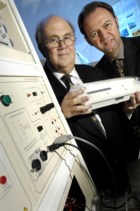
Collaboration in award-winning addressing for emergency lighting — Thomas Lovell of Kablefree Systems (left) and John Wilkinson, knowledge house manager at Northumbria University.
A radio-based system for addressing emergency-lighting fittings has won two awards in the Technology & Innovation Awards for 2007. The addressing system used in emergency luminaires from P4 is powered by batteries and does not require data cabling. It is efficient and clean to install anywhere, which is a special advantage for hospitals, clinics and medical centres. This development is the result of collaboration between P4 (a company which specialises in testing emergency lighting), Kablefree Systems (an electronics company specialising in alarm systems operating via radio signals) and a team of micro-electronics experts from Northumbria University. The concept won first place in the SME section and also the university-collaboration section. The awards are backed by BAE Systems. Alan Daniels, business-development manager with P4, explains, ‘Normally emergency lighting requires an extra set of cables for control and information transfer. By producing a radio-based, computer-addressable system, it can be installed at great speed, without the cost of additional data cabling, without affecting the buildings users and without causing damage to the structure. The system offers major advantages in buildings already occupied.’ The system has already been successfully installed in a London hospital.
For more information on this story, click here:
Nov 07, 105Related links: