School maths department counts on natural ventilation
School
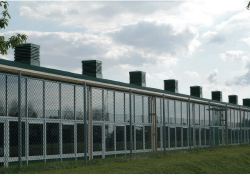
To provide natural ventilation and prevent overheating in this new mathematics block at a school in Dorset, Monodraught Windcatcher units have been installed in each classroom.

In response to Government policy to exploit natural, energy-saving solutions in schools, ventilation for classrooms in the new mathematics block at a school in Dorset is provided by Monodraught Windcatcher natural-ventilation units. The first step in the project at Corfe Hills School in Broadstone was to determine fresh-air requirements for the classrooms and the predicted heat gains, taking into account solar gain and some cross-ventilation for perimeter windows. That analysis led to the installation of ten 800 mm square Windcatchers in the classrooms and staff room. They terminate about a metre above the ridgeline. The school’s assistant bursar Nick Hunt explains, ‘The system means that the roof temperature in the maths block is controlled extremely well. There are other parts of the school with a flat roof where the solar gain is quite onerous, particularly in summer. We simply don’t get those temperature issues in the rooms ventilated by Windcatchers. ‘Running costs are so low, almost non-existent, that the system pays for itself over the years.’ Over 700 schools have been fitted with Monodraught Windcatcher systems to provide ventilation and address over-heating issues. Prof. Terry Payne, managing director of Monodraught, explains, ‘The system works through normal atmospheric properties where warm air rises and decreases the air pressure so that cooler air falls into the room. This is a subtle change in air pressure, producing only enough airflow to make the room comfortably fresh. Stale and stagnant air is extracted by the wind blowing on the windward side of the Windcatcher, with the stuffy air going out through the leeward side of the ventilation stack.’
Related links:


modbs tv logo

BCIA welcomes tougher commercial building energy standards but calls for greater ambition across the wider sector

The Building Controls Industry Association (BCIA) has welcomed the government’s confirmation that privately rented non-domestic buildings over 1,000 square metres in England and Wales will be expected to achieve a minimum EPC B rating by 2031, describing the move as an important step forward in improving the energy performance of the UK’s commercial building stock.

GOLDBECK commits to three-year schools partnership to inspire Cardiff’s future construction talent

GOLDBECK has launched a new long-term education initiative in Cardiff, committing to support three local primary schools as part of a programme designed to introduce young children to enterprise, careers and the wider world of construction.