


Passive House standard moves to new level
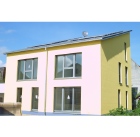
The world’s first Passive House Plus building is this single-family home in southern Germany. It combines the features of the Passive House Standard with the generation of renewable energy on site or near the building, at least a third of which is available for export.
The building in Ötigheim has a heating demand of 13 kWh/m2 per year, below the Passive House Standard of 15 kWh/m2. Its annual demand for renewable energy is 28 kWh/m2 for total floor area, compared to the upper limit of 45 kWh/m2.
A 64 m2 photo-voltaic system on the south-facing roof generates 76 kWh/m2 of ground area per year, compared to a minimum requirement of 60 kWh/m2 of renewable energy.
Passive House design criteria include a high level of energy efficiency through an excellent level of thermal insulation, triple-glazed windows, heat-recovery ventilation system, airtight building envelope and a design that is largely free of thermal bridges.