


Hamworthy meets urgent need of special-needs school
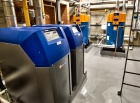
So great was the risk of complete boiler breakdown in a plant room at Abbey Hill Academy in Stockton-on-Tees that replacement was a high-enough priority to secure funding from the Conditioning Improvement Fund provided by the Education Funding Agency (EFA). The new equipment consists of Hamworthy cast-iron condensing boilers and direct-fired water heaters, which were identified as the best solution to be fitted to the existing heating system.
This school for children with learning difficulties has 300 pupils aged 11 to 19 accommodated in three buildings. It was in the main Stephenson Building that boilers were close to breaking down.
Two old cast-iron sectional boilers supplied heating and hot water the 18 classrooms. There were replaced with two Purewell VariHeat cast-iron condensing boilers with a combined output of 360 kW.
In the same building were old atmospheric water heaters supplying hot water for showers, sinks, basins and the main kitchen. They were replaced with two Dorchester DR-FC Evo direct-fired condensing water heaters to replace old water tanks and vastly improve water pressure. Their total output is up to 1200 l/h.
For Philip McHale, premises and facilities manager, the attraction of Hamworthy was a free site survey and a complete package of supply to commission. The new equipment was installed by Leybourne Urwin Ltd