


VRF meets ground energy in Paris renovation
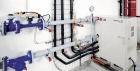
As part of a major renovation to reduce the energy consumption of the Paris headquarters of Bouygues Construction by 90%, chilled-water air conditioning has been replaced by an LG VRF system rejecting heat into existing main chilled-water circuits. The Challenger headquarters office building at Guyancourt in the suburbs of Paris houses 78 offices over three floors with a total area of 70 000 m2. The objective was to reduce energy consumption from 310 kWh/m2/year to 31 kWh/m2/year.
An important design feature of the ‘outdoor’ units is a specially developed system for controlling water flow — similar to the principle of fan control on air-cooled VRF outdoor units. A variable-flow water loop was essential to minimise pump consumption. Other technical issues needed to be addressed to avoid bottlenecks.
Hervé Sartory, directeur prescription and grandes compte for LG in Paris, explains, ‘Nobody at that stage had developed the water flow-control technology, so some investment was obviously needed by the manufacturers.
The solution developed by LG enables the outdoor units to send a 0 to 10 V signal to the valve, depending on load. When the load is low, the valve closes, and low water flow is ensured.
A sample unit was installed in a annexe machine building. LG supplied three engineers for two weeks to perform the installation, commissioning, test, take measurements and apply different patterns of configuration.
Engineering consultant Ferro Ingenierie subsequently specified 53 LG Multi V Water II units with heat-recovery outdoor units supplying 426 duct heat pump.
70% of the heat is rejected by four adiabatic dry coolers and the rest into the ground and ground water. There are 70 vertical boreholes 100 m deep and one of 200 m deep.
There are 25 000 m2 of photo-voltaic panels on roofs, terraces and in a solar farm — generating 2500 MWh a year.
The project has exceeded its energy objectives and is a positive-energy building.Three international building cerfications have been achieved — HQE, BREEAM and LEED.