


Danfoss valve controls and balances heating systems in one
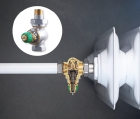
Danfoss’s Dynamic Valve achieves temperature control and automatic hydronic balancing in a single product. Designed for installing at radiators, this device combines a thermostatic radiator valve (TRV) and built-in differential-pressure controller. The latter eliminates pressure fluctuations, a common cause of heating-system complaints such as noisy radiators, uneven heat distribution and unacceptably high levels of energy waste.
These valves are easy to install and offer faster commissioning. They also reduce the amount of water circulating through a system, making it possible to optimise pump settings or reduce pump size.
Using an industry-standard 1 to 7+N scale, each valve can be set quickly to a maximum flow rate from 25 to 135 l/h, and the flow is not affected by normal pressure fluctuations. The system balance is not affected by building occupants adjusting a radiator thermostat or valve settings.
The Dynamic Valve was developed as a cost-effective alternative to Danfoss’s ASV valves and offers an economic choice for a wide range of buildings using 2-pipe radiator systems having only a few radiators on each riser.