


Mitigate risks of fouling small control valves says Frese
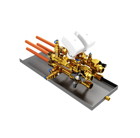
Following the article in January’s MBS entitled Closed systems need careful commissioning, leading valve manufacturer Frese is advising that the risks of fouling small control valves should be mitigated against, because small bores are more common in today’s systems.
The article highlighted the fact that many components in modern hydronic systems have increasingly small bores to provide the future operating efficiency of the system and are therefore susceptible to problems arising from poor water quality.
Whether conventional or pressure independent, small flow paths are unavoidable in DN10 and DN15 two port control valves that are sized correctly for good temperature control at low flow rates and extra care should be taken during system filling and flushing to ensure problem free commissioning.
BSRIA amended the BG 29 Pre-commission Cleaning of Pipework Systems publication in 2012 to include a flow side drain between the control valve and the terminal unit to allow the coil to be flushed directly at full flow without the flow passing through the two-port control valve.
Frese supports this recommendation of BSRIA and offer flow and return side drains as standard on the MODULA Direct valve assembly, which typically includes an OPTIMA Compact PICV.
Furthermore, whilst the OPTIMA Compact can pass a 2.5mm particle down to 0.028 l/s, we recommend an integral strainer be fitted within the valve assembly to protect the PICV from fouling when ultra-low design flow rates down to 0.008 l/s are required.