


Dimplex provides support for new heat-pump standard
Dimplex is helping installers get to grips with a new installation standard for heat pumps that came into effect from February 2012. Chris Davis, business-development director with Dimplex Renewables, says, ‘We believe MIS 3005 is a positive move for the industry and will help heat-pump systems deliver the consistently high performance that’s needed to encourage the uptake of renewable heating in the UK.’

Gary Perry describes how Norland Managed Services has been helping clients to reduce their energy consumption — starting with simple and low-cost measures.

50 kW solar PV system for Warwick Hospital
Warwick Hospital has become the second hospital to benefit from solar energy through a partnership between Community Energy Warwickshire and South Warwickshire NHS Foundation Trust. This 50 kW solar PV system follows a 10 kW installation for Stratford Hospital. Both were installed by Eco2Solar.

Ashworth launches sustainable range
Ashworth, a national distributor for the mechanical-services industry, stocks a comprehensive range of renewable-energy solutions. They are featured in a brochure, which also includes coverage of key issues and schemes to be aware of — including the Feed-in Tariff, Renewable Heat Incentive and Microgeneration Certification Scheme.

For several years Mitsubishi Electric has been making steady and progressive reductions to the carbon footprint of its headquarters at Hatfield, with a dramatic effect on the Energy Performance Certificate. Martin Fahey shares his experiences.
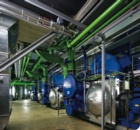
Delivering energy efficiency with district energy
Centralised energy centres serving district energy schemes are making a growing contribution towards achieving low and zero carbon buildings. Simon Woodward discusses the key issues for specifiers
A large apartment development in Richmond has achieved Level 4 of the Code for Sustainable Homes with help from Total Home Environment, which specialises in mechanical ventilation and heat pumps.

Making light work of energy efficiency
Lighting is widely recognised as one of the best starting places to reduce energy costs in the built environment. Graham White and Greg Herring outline the key issues to consider.

AET launches solar-thermal collector
AET now offers the Camel Solar high-efficiency evacuated-tube solar thermal collector, which can absorb over 92% of the Sun’s energy that lands on it. This capability is said to make it one of the most efficient solar collectors on the market, with a stagnation temperature of 250°C. Evacuated tubes enable these collectors to work effectively even during the coldest months of Winter.

Radiators meet green heating systems
The low water temperatures that characterise heating systems using renewable energy do not preclude the use of radiators, says Chris Edwards, marketing director with radiator manufacturer Purmo. He says, ‘Even in countries with harsh Winters such as Sweden, radiators are accepted as an integral part of a modern, efficient and green heating system. Our low-temperature-technology products prove that radiator-based heating system provide a quicker a more consistent heat distribution in many settings.’

Maintaining pressure on energy consumption
Existing buildings can benefit from a considered approach to substantially improve their energy efficiency. David Lewis outlines four simple steps to achieving energy efficiency and the notable savings that can be made in the process.



ICOM celebrates Noah Gaunt as Apprentice of the Year 2026
Noah Gaunt of Vaillant Group UK has been named ICOM’s Apprentice of the Year 2026, recognising his outstanding commitment, technical excellence and passion for advancing the future of low carbon heating.
BCIA warns non-domestic buildings risk being overlooked despite decarbonisation drive
Commercial and public buildings risk being left behind in the UK’s transition to Net Zero despite more than £40 billion of funding, investment and policy support being directed towards building decarbonisation, according to the latest Policy Pulse report from the Building Controls Industry Association (BCIA).
